Hoarding things makes me feel weird. Like existentially sad pondering my own mortality weird. I have all these great collections that are scribbled full of women’s names and these mother sized and daughter sized patterns that have scribbled notes about cancer fundraisers on the envelopes. I have things that I know someone tucked away because she deemed them worth keeping for the duration of her life, and then were passed on. It’s the same kind of discomfort that keeps me away from estate sales. To me that’s the saddest thought–of someone without family members willing to take her treasures and think of her now and then while enjoying them. Humans are these strange attention machines, meaning-making creatures filtering that take in all this influence and cultural symbolism that makes an individual taste and personality. Then that aesthetic (along with that individual’s neuroses and instinct) becomes this drive that curates and assemble these possessions, especially in the industrialized, advertising soaked West where we affirm these ideas about ourselves and our aspirations by purchasing. They become a kind of expression in themselves of the curatorial eye that gathered them. Seeing them dissipated and hawked on ebay by people who don’t know a thing about them is just…sad to me. I hope someday that my hoarded things aren’t shuffled through by strangers hoping to make a profit. I have a big family. I hope some distant cousin will get use out of my books and sewing machines, that maybe my kiddo will hang on to the handcrank I hope he’ll remember fondly one day being allowed to “sew with mommy” on.
My interest in home economics and domestic arts is fraught with sentiment, I guess. There’s a scene in True Blood after Sookie’s grandma dies where she’s sort of numb and disassociated from her grief until someone tries to eat the leftover pie in the fridge that her Gran had made. She screams at her to put it down, and later, almost ritualistically, she sits at the table alone, sobbing and finishing every last bite of the pecan pie. That scene was the most powerful for me in the whole gloriously costumed, pretty people laden Southern goth extravaganza that was True Blood. But then, I’m the kind of girl who still keeps a cigar box full of useless dried up pens that my dad used to write with. His handwriting was almost calligraphic, and he sat down to write like some people sit down to a tea ceremony; but he was just like that. Chopping wood, sharpening knives, too. Somewhere I have a bag of his old clothes that I couldn’t bear to throw away. I may be 80 before I ever end up making a quilt out of it, but I hope one day I do, and that someone I love enjoys it long after me, too.
There must be some kind of gene that sentimental hoarders share, because this doesn’t seem an odd sentiment among crafters. I wonder if there is some neurological idiosyncracy there that we share. I have this pipe dream of going all minimalist and paring my life down but the minute I start to think about cleaning out something I can conjure up all these memories of associated things and can’t discard it. And yet I don’t keep scrapbooks; why would I need to, when shuffling through a box and its smells and textures evoke more than a picture ever would.
tl;dr: Sorry, boyfriend, you trip over sewing machines when you go to do the laundry bc your girlfriend is a hopeless sentimentalist. The end.
My recent bellbottomy pants turned out fantastic. So excited. I would post pictures but there’s not any possible way to get a good picture of your own pants. It cannot be done. *sigh* Turns out flattening the front and putting the vast majority of the crotch curve on the back pants piece does wonders for the camel toe/monobutt fitting problem. So for my next source of frustration/bafflement I want to make THESE (please excuse the awkward bathtub scene…Gah. Or maybe that’s just my sexual repression speaking):
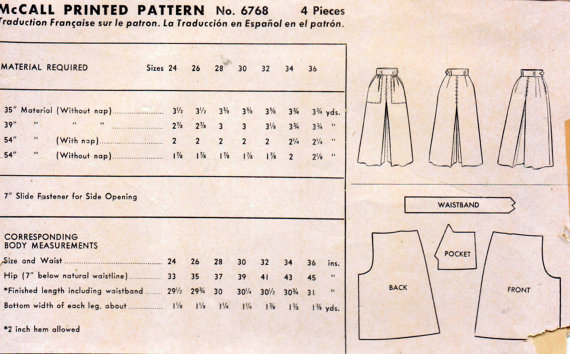
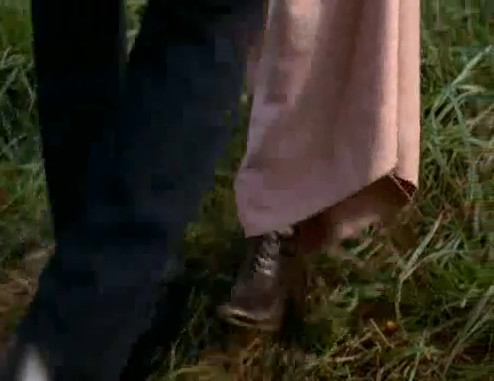
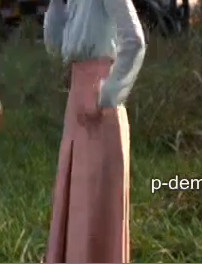
This is Hillary Swank in Iron Jawed Angels rocking some glorious, glorious pink culottes. I love the way they look when she’s in motion, and I *love* the waistline fit. I think there’s a subtle difference to the look of split skirts/culottes vs palazzo pants, so my goal is to get that right. There is a nice pair of 40s culottes on etsy (here) where the skirt is cut in two pieces, with the crotch division sort of grown on the pieces.
If you wanna see something crazy, watch this tutorial video where a braver sewist than me freehands it (no pattern!) (here). Not quite the tailored look I want, but interesting stuff!
There’s another 70s style pattern with more pieces to cut available on etsy (here)
I’m thinking these might be better for the skirt illusion, but the last sort of piece of the puzzle for me is the is the box pleat…there is an incredible tutorial to draft a pair to one’s own size with the box pleats (here) at Petit Main Sauvage but the box pleat discussion isn’t quite for-dummies enough for my current sewing level, so I had to try it origami style to get the mechanics of it through my head. And now I’m ready! I swiped some screenshots from the above video to fangirl about the details a bit.
I love how flow-ey this is, so to preserve that I should probably use a fabric that isn’t too heavy or too stiff. It has a nice way of falling and draping the curves of the leg.
It looks like the hem might be a bit higher on the outside of the leg than in the center, but it’s hard to tell. It might just be the way it’s falling with her movement.
Not sure if this fit would be so flattering on someone with more of a potbelly (moi) than Hillary Swank, but I do love it here. Very fitted at the waist and through the hip and butt, and then it begins to flare at high mid thigh.
Today I am on a mission. I lost my sailor pants pattern (oh, the downsides of being a hoarder) which I had perfectly tweaked via trial and error to avoid the camel toe problem. I like tight-ish pants, but cannot, cannot, cannot stand when they appear to bifurcate my front crotch. Do. Not. Want. It occurred to me while fangirling over David Bowie and how he always manages to have this epic boldy-move-through-the-world-with-his-crotch posture in his rock star jeans (see exhibit A below) that men’s jeans must not have this issue, since they have to deal with a bunch o’ stuff in the front.
I’m sorry, Bowie, but the line between objectification and inspiration is a very thin one.
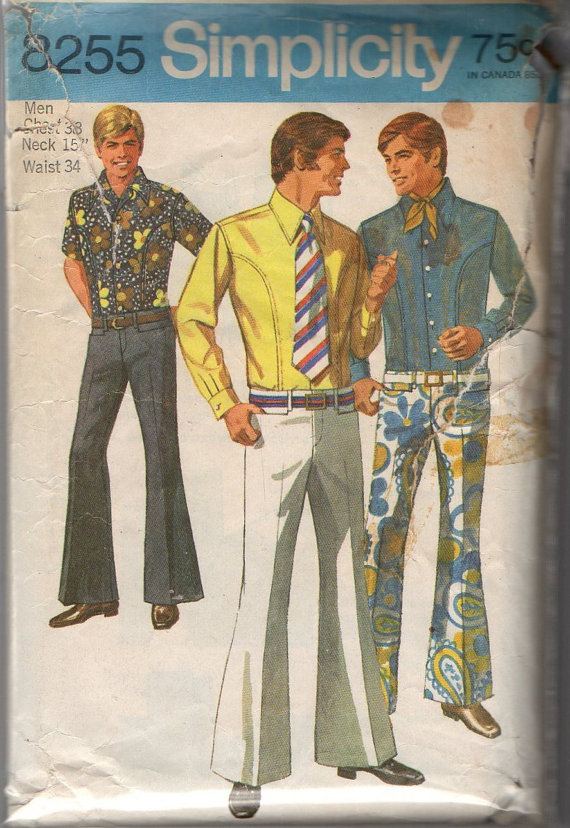
I *also* very much dislike the contemporary cut of jeans that Kathleen Fasanella terms the “monobutt” and discusses at length on her blog at fashion-incubator.com. So much food for thought there. I’ve been studying pattern envelopes from the disco era, ’cause god knows if you were gonna gyrate at the disco with all the fervor cocaine could induce, you could not have your crotch and butt being all bound up by the cut of our your super tight super fine pants. Exhibit B: This fantastic 70s pattern, which incidentally features princess lines on a men’s shirt!!
This is available on etsy (here) at the moment. What I find fascinating is the cut of the back piece vs the cut of the front piece. For most pairs of women’s pants I’ve sewn from patterns, the curve is pretty equally divided between front and back pieces. This keeps most of the curve on the back piece, which makes sense, because the front needs to be flatter to accomodate the goods. So if you’re a woman who doesn’t want the camel toe look, my thinking is that you could learn a lot from the line here.
What also interests me is the slight pitch of the back piece. That is not a typical up and down straight pants piece. There is curvature to round the glorious muscles of the gluteus maximus. That pattern piece does not squish it into one indiscriminate jammed up mass (that my butt has actually ripped apart at the seams) but rather allows enough fabric to encase it.
If emulating these curves doesn’t work for me, I’m turning to Elvis costumes next. Have you EVER seen an Elvis jumpsuit that gave him a monobutt? NO. Also potential study fodder–karate pants. I did karate as a teen and those drawstring uber-comfortable pants saved me during my pregnancy. I wore them almost daily. They are designed for movement, with a large gusset in the crotch, and aren’t exactly the look I’m going for at present but I could learn a lot from their construction in my quest to design a pair of superpants. Said quest got a little boost from this cover illustration from Modes et Travaux, which should be arriving in my mailbox any day now. Yay hoarding! Yay Maggy Rouff!
These days I’ve been working on my digitization skills. I am a rabid collector of pattern booklets (among entirely too many other things). They are filled with gorgeous illustration and a wealth of inspiration–I love the unique details and trimmings of the 20s, the fluttery chiffons of the 30s. I thought I’d share some images from my May 1924 Pictorial Monthly Fashion Book, which I’ll be making into a pdf and putting on Etsy, if only for other completist/hoarders/rabid OCD fueled types who might want the reference material.
Etsy shops with vintage sewing materials are an interesting phenomenon; I’ve been sort of studying them. Reproduction patterns are a wonderful thing, but I can’t help feeling a bit irked when people charge $12 for a photocopy or scan of a *single* draft-it-yourself Ecoupe Clair pattern. I’m glad there are people who hoard these things and make them available, but my recent purchase of a 20s lingerie “booklet” was just photocopied instructions from a Woman’s Institute magazine, uncredited except as “original source material from 1928.” Not gonna name the particular person because I actually sort of like her, have bought vintage original booklets from her, and I know she’s just making a living and making rare materials available again–but something about it seems off to me somehow. The Amy Barickman books “Vintage Notions” and “Magic Patterns” are similar–just repackaging of Inspiration magazine from the Woman’s Institute and representing the patterns within it in a modern graphic design packaging. It bothers me somehow that someone would claim authorship in such a way of someone else’s incredible work. But at least Amy Barickman did digitize the patterns into a pdf and write her own instructions. I don’t know. When I start offering my own patterns drawn from vintage sources, I intend to be a bit more…forthcoming? less price inflated? about my work as a “pattern designer.” There’s a difference between being a pattern designer and a seamstress/collector with a scanner, in my mind. Is that snarky? Probably snarky. But also true.
But I digress.
These old pattern booklets are hard to find and most of mine wither to the touch with the chipping, brittle edges and cracks. I love to look at them but am afraid to handle them much, so the digitization is a tricky process. Compound that with these being oversized and too large for a single scan and it’s been a delicious little challenge. But these images are gorgeous. 1922-1927 is my favorite pattern illustration era, I think. The 30s might be my favorite in terms of silhouette, but these colors! These textures! These women looking at you with that Cheshire cat all-knowing look in their perfectly fitted ensembles. *swoon*
Amid the frustrations of work today, I decided to do a little sewing machine tinkering to get my zen mindfulness on. There’s something about brushing out the dust, oiling and waxing these old things that mellows me out. Industrial chemical fumes perhaps? I really should buy myself a facemask one of these days.
My project for the day was this ebay find, which of course came with a beautiful wood base that was utterly demolished in transit because people seem to forget that antique wood is fragile and sewing machines are heavy and the postal service is not big on delicate handling of the bajillions of packages it throws around each day. However, it’s still an awesome machine.
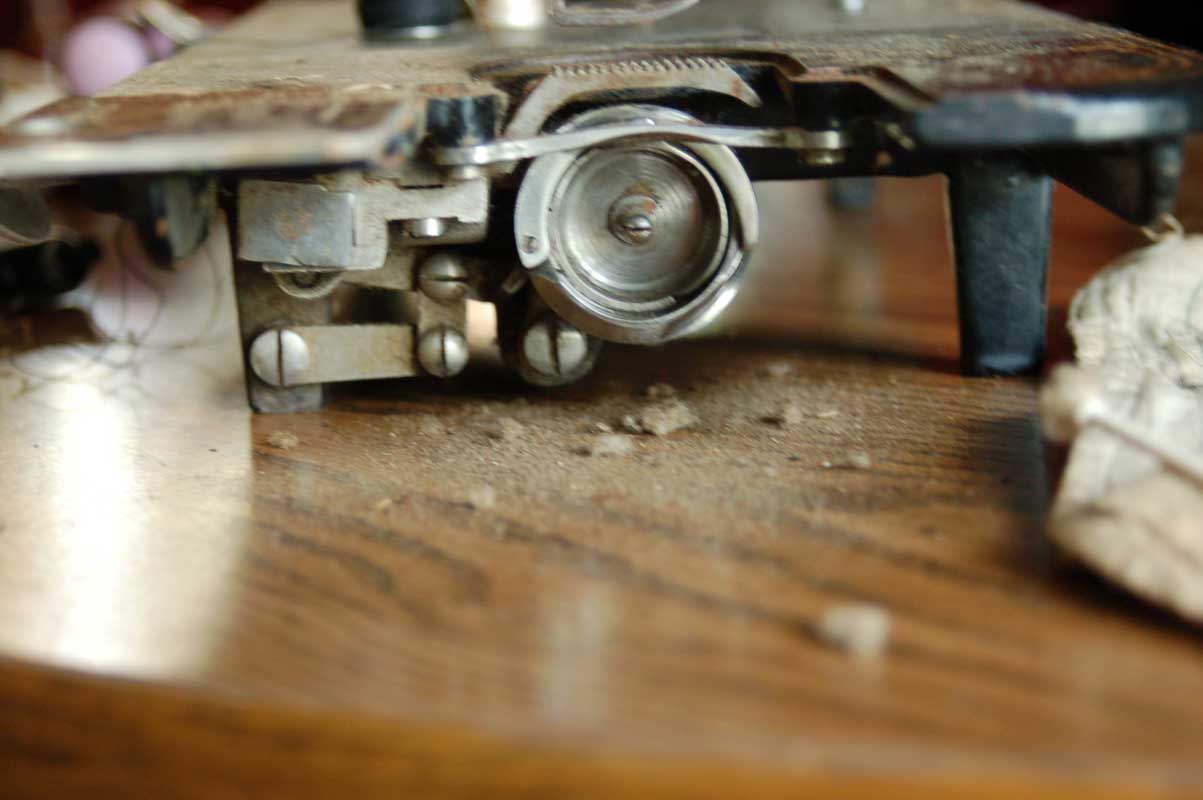
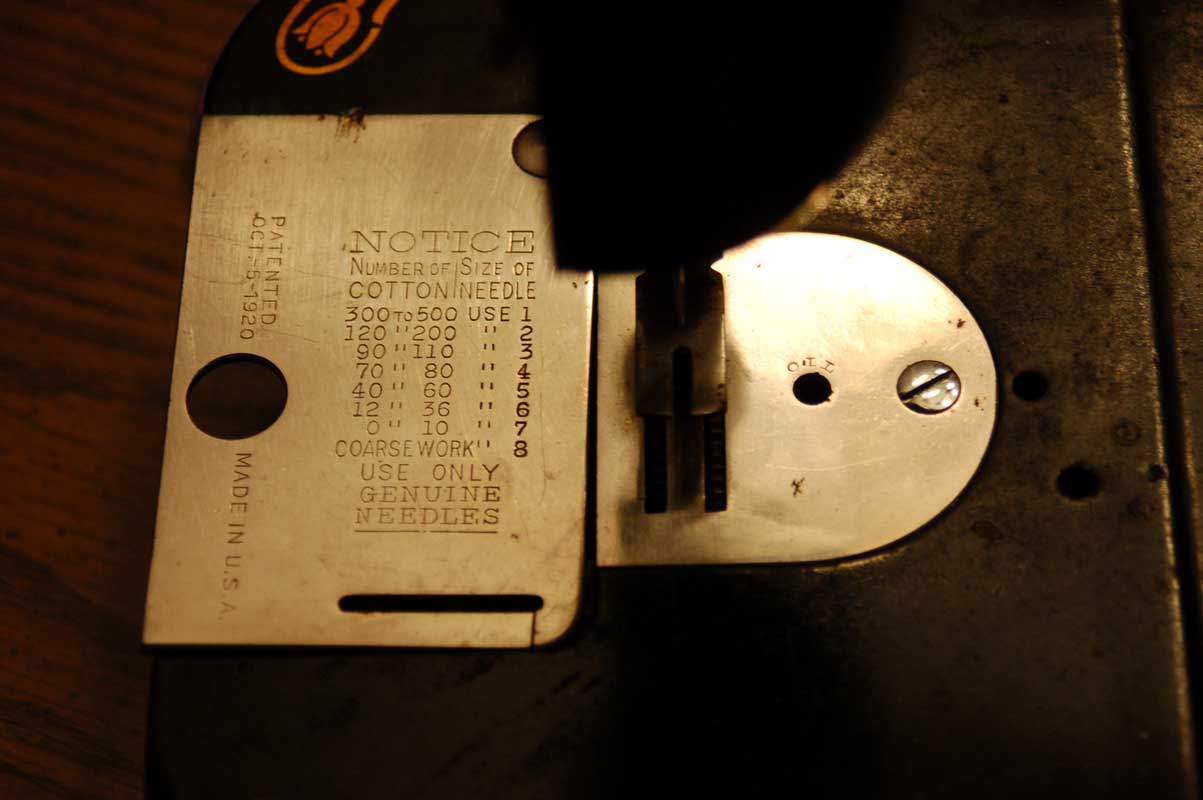
The Improved Eldredge Rotary B. (This is before I cleaned it.)
It takes unusual 20×1 needles, of course, being of the era (30s?) when every sewing machine company sold needles for their machines. The needle is similar to the modern 15×1 system, though, in that it’s flattened on one side. (If I *really* wanted to, I could probably put a standard needle in but not push it all the way up into place and make it work, though it wouldn’t be as stable as it should.)
It has a friction drive motor, which isn’t all that unusual (some other machines like Whites and mid-century Elnas have these too) but it’s actually built or snugly wedged into the body rather than mounted on it. So far I can’t see any way to remove it. It also has the unusual Chicago post electrical set up. The foot pedal and sketchy cord that go with it were also demolished during shipping, not that I’d have trusted them anyway. But that will be a scary rewiring job, if I try it at all, because I’m very newb at electrical systems and the Chicago ones aren’t polarized and I don’t yet know what that means for rewiring a machine. (And this machine wasn’t intended as a workhorse so I don’t have to have it running to enjoy it, exactly; I bought it because of the art deco styling and its idiosyncracies.)
It was so, so, so dirty.
But it cleans up nicely!
The threading is unique. I have another older Eldredge and both have more steps than most to thread them, but once threaded correctly the stitch was very nice and even, especially since I was turning the machine by hand. The stitches have an interesting antiqued look because of the dirty, probably 60+ year old thread in the bobbin and the tarnish on the presser foot. There’s something about that patina of age I like–I’m not as intrigued by machines that look new as I am by machines that have a history to them. (Same thing with faces, oddly enough–the older I get the more bored I become with straightforward beauty. It seems so blank, so simplistic; I enjoy looking at faces with more of a story told in them. Interesting how one’s ideals about beauty and aesthetic appeal change over time.)
This blog post (here) links to a complete manual (bless you, Anne Graham, for posting it because I’d have never threaded it otherwise.) And it also links to a source for needles, bobbins and bobbin cases (here), which is incredibly helpful for machines this old and scarce.
So for a clean and oil job, I’m pretty happy, but there is still some tightness I’d like to work out, and this plug/wiring system is a problem to puzzle over too…
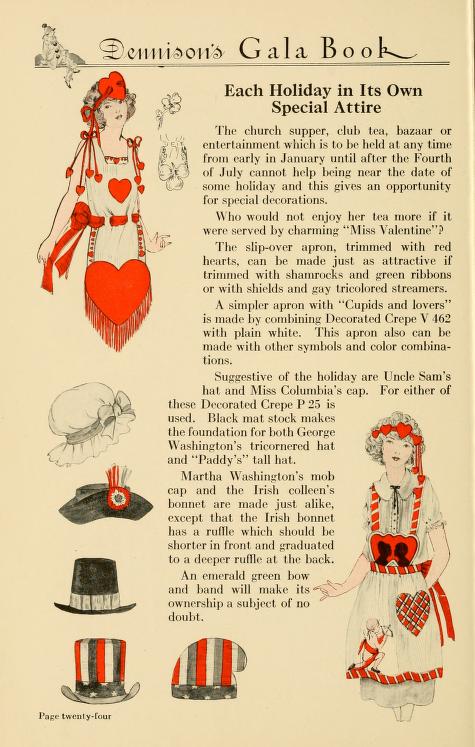
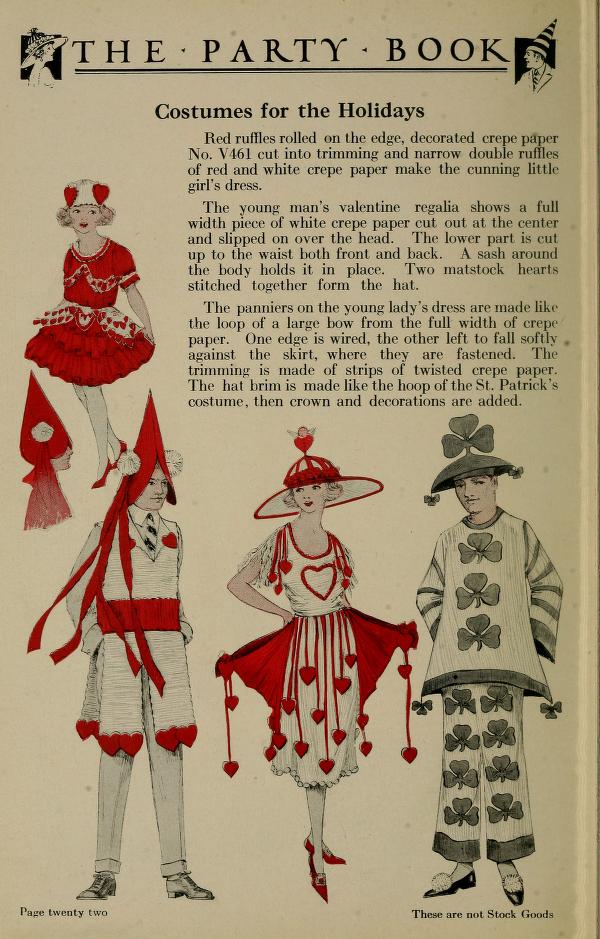
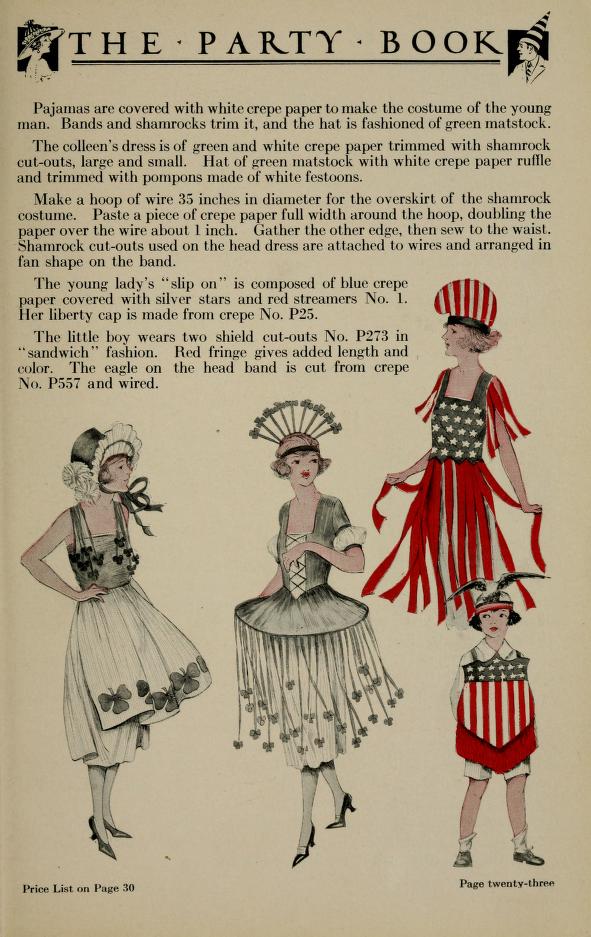
I have a thing for vintage costume catalogs. I just love the idea of people having galas and dressing up to socialize; there just isn’t enough of that these days.
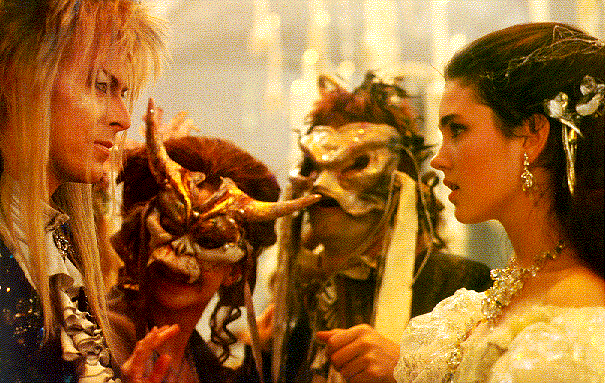
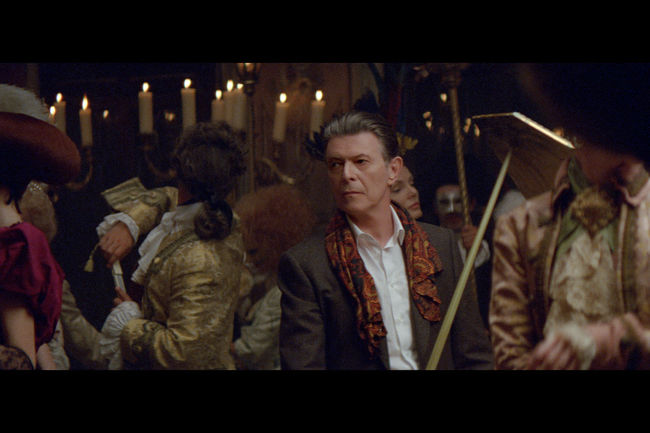
Still waiting on my invite.No, seriously, guys. Give me the poisoned peach.Still waiting. Why are there no creepy masquerade balls with David Bowie as the musical entertainment in my life!??
It is interesting, though, how some people bemoan contemporary Halloween as merely an excuse for people to wear skimpy things and get attention. But old catalogs I see seem to allow for more skin and more leeway in terms of socially acceptable dress (women in PANTS in the 20s?!) even back in the early 20th century. The issue of dress and pervasive sexuality in our culture is a complicated one, but I have a feeling that even when people barely even showed calves, those calves were probably viewed with the same sexual fervor that, hmm, say, Kim Kardashian’s implanted butt is today. I tend to think that human drives and fears and aspirations and perversions remain largely unchanged through history, though we tend to look toward the past as if those people were completely different than we are–and toward the future generation as morally worse than us, change as bad, social mores as crumbling. And yet we as a civilization have managed to not yet fall apart after millennia of supposedly worsening moral depravity. Hopefully some of our biases have been stripped away in terms of gender and race over the last hundred years, but I think sometimes we as a culture collectively pat ourselves on the back far too soon–as if we’ve fixed those complicated social justice problems. (Arguments about the irrelevance of feminism in our time now that it has “completed its goals” come to mind. Ha. HA! Or cultural appropriation and fashion, the outrage over the Redskins being asked to change their mascot to, you know, maybe not a highly offensive caricature.) But…rants make me tired these days. In the echo chamber of social media, the world is flooded with loudly broadcast opinions. We have maybe enough of that. But not enough of Dennison’s ephemera!!
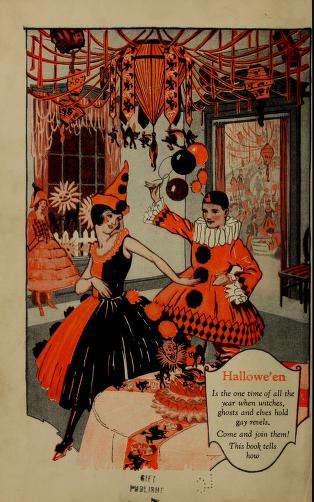
Apparently Dennison put out these sweet little booklets starting in the late 1900s or early 1910s, most of which are now stupid expensive collectibles or reprint editions. But archive.org has three of them! They are mostly full of household decorating tips, party planning and crafts, etc, but there are some amazing illustrations and costumes in them too!
Exhibit A: Dennison’s Bogie Book from 192o. It can be downloaded (here).
Exhibit B: Dennison’s Gala Book, 1922, can be downloaded (here).
Exhibit C: Dennison’s Party Book, 1922, can be downloaded (here) Admittedly I am unclear on the difference between a gala and a party…probably a matter of scale/formality?
That guy’s hat looks like something out of Eyes Wide Shut. Creepy.
Happy Memorial Day! Ours was spent battling a broken air conditioner, dealing with a barfing young’un and the compulsory roasting of requisite meats but all in all, a pretty good day. Had some time to play in my ephemera collection, so it was Read-Up-on-Fashion-Service-All-Day Day at our house, too. Well, for the significant other I think it was more Read-Up-on-Vampire-Fiction-Day, but to each his own.
The Woman’s Institute had (to my knowledge) two publications that came out regularly to supplement their educational materials. While the educational books are more general, universal stuff, the supplementary publications are more era-specific, individual fashion content. I’ve been on the lookout for these little marvels lately, and it’s been like a fun, stupidly expensive treasure hunt trying to figure out the print history. (The curse of being incredibly obsessive is tempered by the Indiana Jones-esque thrill of discovery I get from trying to put this all together.)
Bears a striking resemblance to making a credit card payment, yes?
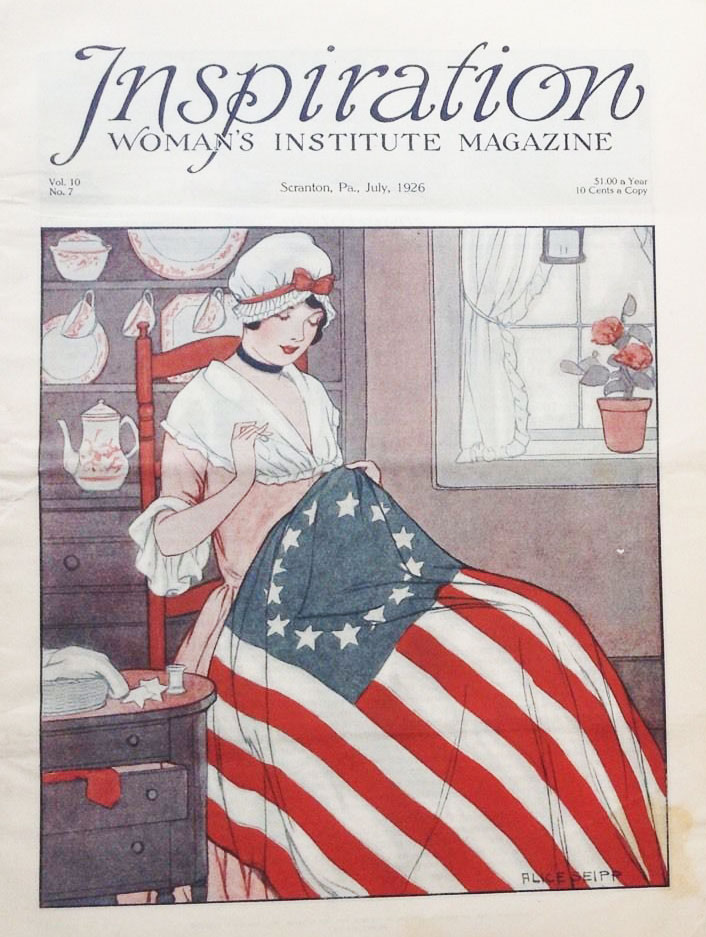
One publication they put out is called “Inspiration,” pictured above, illustrations by Alice Seipp as usual, which seems to have been published from the beginning of the Women’s Institute, though it is extremely rare and barely even referenced on the Interwebz. Evidently at one point, Bramcost (who publishes a lot of reproductions) had a few of them available for purchase on Amazon (see here, here and here), and occasionally they must pop up on ebay, but never when I am looking for them, alas. I found a few at Garrison House Books, and Tess, one of the owners was kind enough to send me one as an extra special surprise when I bought another publication from them (<3). While I could probably fall down a hole trying to track down more, one must choose ones white whales carefully. I guess. Sigh.
The other publication the Woman’s Institute regularly offered was the Fashion Service magazine. It seems to have been intended initially as a supplement for students exclusively, but then later offered for subscription to anyone who subscribed. I had been unable to figure out when the Fashion Service began being published, but recently found a horribly water damaged copy of an issue from Winter 1920-1921 with an insert, torn and cockled. (Google tells me that “cockled” means rippling of paper usually caused by water exposure; of course from now on my inner pervert will work that into conversation any way possible.) The magazine is *almost* beyond hope but according to the insert, it’s the first issue. YAY. The insert (and the magazine) are credited to Mary Brooks Picken, who writes in her usual charming, encouraging way. And it also represents one of the only references I think I’ve ever seen in a vintage sewing text to sewing a muslin–most seem to suggest tissue fitting, basting a garment together, or measuring at least 37x to make sure that pattern is going to fit your actual body before you cut. (Burda and Gertie’s Blog discuss here and here, respectively.) So here, transcribed from its cockled wobbly almost-entirety, the insert from the first ever Fashion Service. (Which, for any fashion history junkies/freakish OCD completists like myself out there, I’m in the process of laboring over and cleaning up in order to offer pdf and paper reproductions on etsy. It will take me a bit, as the warping of the pages plays hell on scanned output, but I’ll get it!)
My dear Friend:
One early autumn afternoon, four years ago, just after I had returned from a very elaborate fashion fete, my mind ablaze with the possibilities of developing beautiful garments, I promised myself that the Woman’s Institute should some day have a semi-annual Fashion Service–a service so comprehensive and instructive that every member might know the joy of seeing the new things and have an opportunity to become intimately acquainted with the lines, colors, and fabrics in reign for the season.
At that time the war was on, our student body was small, and there seemed to be a thousand and one reasons why we could not have a Fashion Service immediately. My realization of this meant great disappointment to me. So I have waited, but I never gave up the idea nor allowed anyone at the Institute to forget that some day we should have a really truly Fashion Service–one that we could all be proud of and that our students could be happy about.
In my messages to you through “Inspiration,” I have many times voiced my belief that earnest desire is prayer and that prayers are answered. My prayer for this Fashion Service has been answered. And, now–here it is with this letter.
I believe you will find on every page information and inspiration that will help you make for yourself the prettiest, most becoming clothes you have ever owned. Our Fashion Service differs from fashion descriptions in magazines because we have searched the fashion market and selected styles that we think will please you personally and at the same time are definitely representative of the fashions for this fall and winter.
The Institute desires you to use this book in connection with your studies. In preparing the text we have mentioned the kinds of seams and finishes and the plans of construction. If you are not thoroughly familiar with these from previous study, you will find them distributed throughout your lessons.
If you have any doubt about any part of the construction or the development of any garment in the Fashion Service, refer to your lessons. You will find them ready guides and advantageous helpers, for they teach definite sewing and construction principles applicable to any time or mode.
Before you start to make up any of these beautiful garments, I must […remind?] you of the advantages of muslin models, for they are the […essence of economy?], even with muslin at its present price. If they were not so valuable, it is very certain that the best custom shops would not show them with so much prominence and assurance.
You may want to make one, two, three, or possibly four dresses similar to those illustrated in our Fashion Service. But even if you make only one, it is essential that it be right in every detail. So, before you cut your material, develop in muslin a model guide pattern that will give you lines exactly in the right position for your individual measurements.
Experiment with the muslin model; have it just right. Then when you cut your material you can be certain that the garment will carry lines in a correct position for you. In making a second dress, you can recut the model and by adding a yard or two more, have enough muslin from the first model to develop the second one satisfactorily.
I have found that there are two things which lend to home-made effects in clothes: First, the position of the lines, and second, the hesitancy of thought that the dress sometimes evidences. How often we hear a woman say, “I know now, for my build and this material, that this tunic should have been longer, or the shoulder line should have been shorter, or the waist line a little longer or looser.”
Find these things out first from the muslin model and thus avoid errors in cutting. See from this just how the garment goes together and where trimming will be desirable for your, giving very special attention to the shoulder line, the waist line, the collar and the skirt length. Then sit down and make a dress. Your progress will be more rapid and the finished garment will reward you many times, for it will show skill and ripened though–points always evident in the product of a master hand.
The prominent commercial pattern companies were very kind in cooperating with us in developing this book, allowing us to select from their advanced styles types of patterns that will be helpful to you in developing some of the garments illustrated. The name and number in such instances are given, so that you can purchase the patterns if you desire.
To send this book to you is just like sending a cherished handmade gift to a friend who I feel sure will appreciate it. It has been a great task to prepare so that it would be wholly helpful and entirely reliable, but the hours spent on it have been constantly filled with the belief that it would make you happy and help you–and it is sent with that thought, together with all the good wishes at my command.
I’ve been scanning and hoarding, scanning and hoarding lately, revelling in old paper and list-making. Bookworm heaven. Learning new software, working on a real live sewist/compulsive archivist type site design. Even brushing up on my sad, sad French skills because I want to work on some translations of old French pattern drafting books. (Can you tell I’m desperate for brainwork post-college? I was in school so long I can’t function without the structure and the immersion in a subject; sewing history is seriously keeping me from losing my mind as suburban middle age overtakes me.)
Anyway, I thought I’d share a free PDF I made of a vintage pattern mini-catalog. It’s too fragile for much handling so it was a good candidate for scanning practice. 🙂 It’s a fun little piece of Audrey-Hepburn-in-her-heyday inspiration, particularly appropriate since I’m mourning the fact that Mad Men wrapped up. I haven’t seen any of the final season yet–I’m trying to dodge spoilers till Netflix puts up the final season and I can lose three days to drooling over Jon Hamm and Janie Bryant’s costume work as fully as they deserve.
I’ve been playing librarian all weekend, scanning things and researching pattern publications and catalogs. It’s been a great way to distract myself from this weird cold/sinus thing and to play around learning some image editing software. Getting serious about the Etsy shop idea, as most of the stuff I’ve hoarded collected is just too cool to sit on my bookshelf, and a lot of it is really hard to find, in a fragile state, etc., so digitizing it is a good idea. But reading through so much style awesome all weekend has me sort of paralyzed as far as sewing projects. I want to sew ALL. THE. THINGS.
What’s odd is that I’m somewhat oblivious to contemporary trends. It seems like they tend to emerge more clearly in hindsight, anyway, and I’m not at all interested in trying to fit in with any given moment. It’s more like I’m seeking to craft a style using history as a medium for creative expression by picking and choosing from the great designs of the last century. Cascade-y shirt openings seem like a thing now, and I’m seeing more palazzo style pants in drapey, light fabrics with lots of movement. So that’s cool, I guess. Otherwise it’s a sort of blur of skinny pants and weird shapes in jersey and more skin than I like to expose. *shrug* Not a big fan of jersey clingy things either because they make me feel like a walking lumpy sack of potatoes bulging out where I don’t want to.
Anyway, I need some high waisted 30s style swooshy palazzo pants/beach pajamas in my life. (High waisted pants are the friend of the narrow hipped woman with a large stumpy torso who doesn’t want obvious muffin top. Ahem: moi.) And a secretary blouse with kimono sleeves. And now that I *sort of* can digitally pattern draft, I’m going to work on doing those in a pdf format.
Some images of beach pajamas from the 30s for inspiration:
Swoon. I love the ones with a triangular shaped wide waist section (would it be considered a yoke?) in particular. And for the secretary blouse:
Nope, not that Secretary blouse.Well, sort of, but…NOT THAT SECRETARY BLOUSE.Perfection. In seafoam.
The final photo is from Vince Camuto (here) and definitely has a vintage feel with the front shoulder gathering, and the pants it’s paired with have a nice, light beachwear vibe too. Another possibility is the slightly more fitted weskit style (from Etsy here):
I feel this maniacal compulsion to make myself expert on all things Woman’s Institute. To shout its wonders to the world. To missionize. Because holy freakin crap do I love these books. And today, discovering minor differences between editions, I was positively mad with book lust. (See: The 9th Gate. It’s what my life would be if I were glamorous, rich, important and in accidental league/sex thrall with the devil. So not like my life at all except for salivating over old books and caressing them lovingly, creepily, way too much for normal people to find comfortable.) There’s a scene where Johnny Depp starts examining illustrations for tiny differences all wide eyed behind his big glasses–that is me, today.
The most fascinating example of this was the lingerie and underwear instruction books and booklets. I have three different versions–a two part paperback booklet set, and two hardback volumes printed in Britain. I assumed they’d have the same content, but it turns out they are all different! One features Edwardian type lingerie (corset covers, brassieres, knickers), one of the undated booklets features 20s era lingerie, and the final one contains 1930s more contemporary styles. It’s a fascinating transformation and I find it so interesting that around the era of suffrage, the silhouette was loose, unrestricted and free.
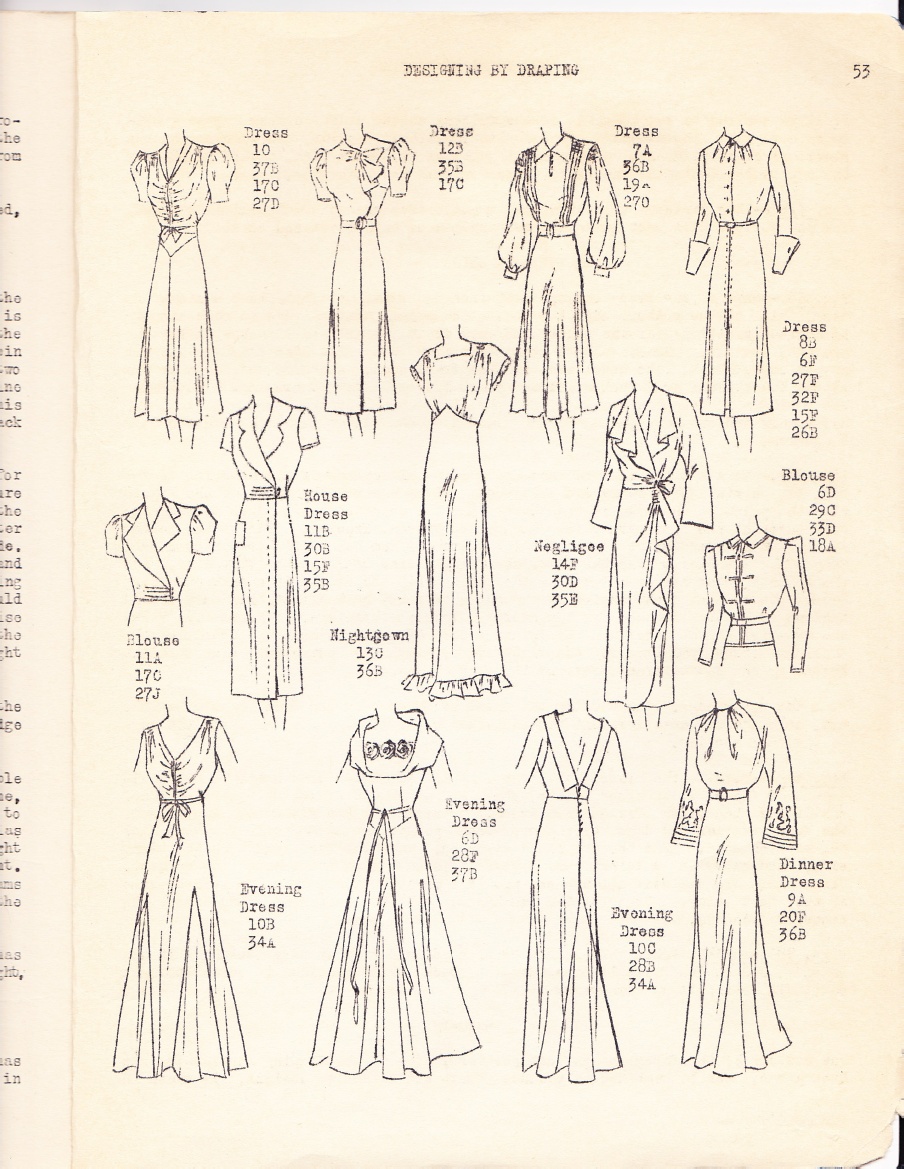
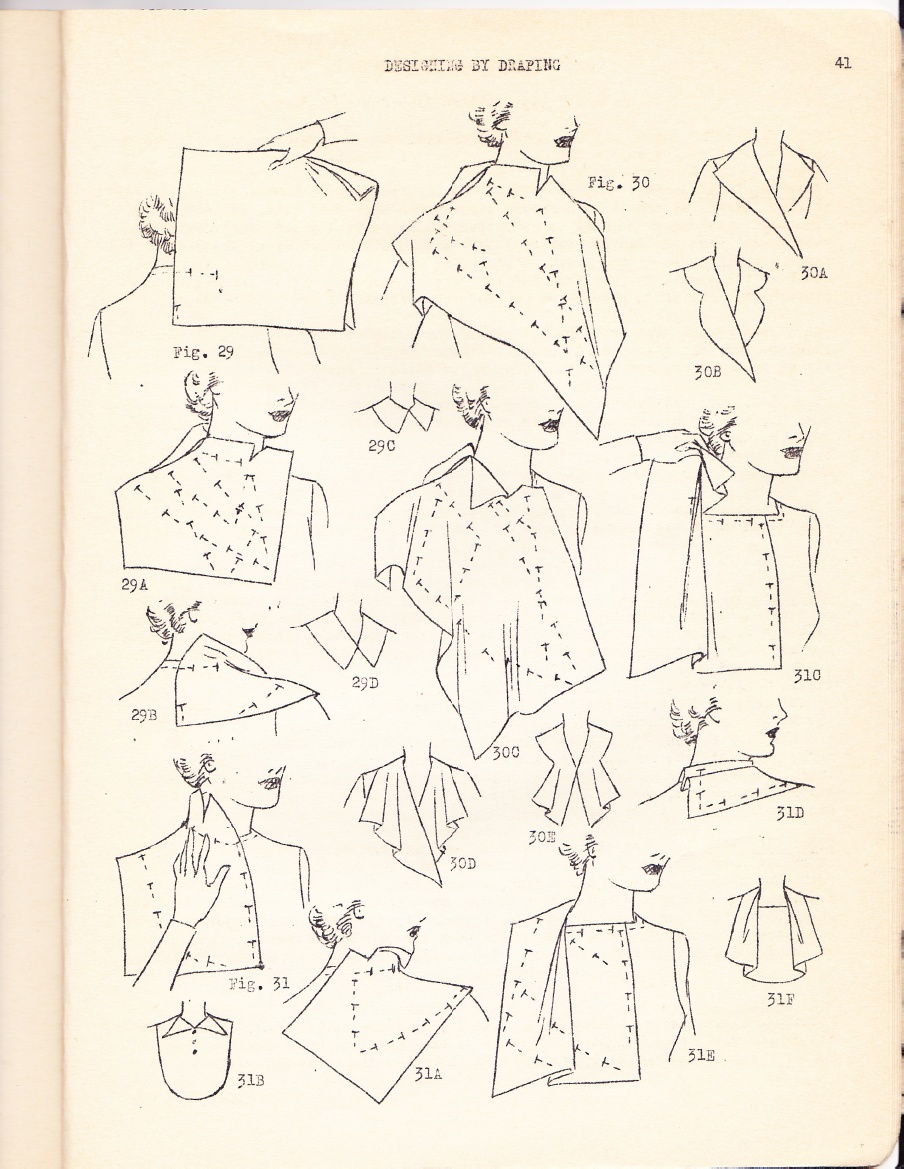
At least one other book has multiple versions with completely different designs–“Draping and Designing with Scissors and Cloth” (1920s version, later renamed “Designing by Draping”), “Designing by Draping” (1928) and Designing by Draping” (1936). This one is extremely rare, though reproductions are available. (Which I refuse, utterly, to buy. I know that the sellers of these are probably just hoarders like myself trying to fund their addictions, which I respect, but I require a facsimile reproduction or nothing. My compulsions demand the satisfaction of vintage page design, typeface, the exquisite yellowing of pages. And if the cover features any kind of crappily rendered, computer-drafting looking piece of crap line drawing for a book FULL of exquisite period illustrations then, um, NO.) And the Woman’s Institute books are all exquisitely designed–except, it seems, the 1936 version, which is available in PDF, for free, courtesy of the lacouturieredimanche blog (here). The illustrations have a different feel, and the text is typewritten…??? The book is genuinely a production of the Woman’s Institute, as the logo/name printing on the cover looks right, and the subject matter and instruction is definitely their kind of book, but maybe it was a very limited run not meant for wide dissemination or it was produced during the era when they were winding down their correspondence lessons. Not sure. But it’s fascinating. (Did I mention the designs are frickin’ amazing? This is my favorite era to date–the collision of art deco and the coming 40s power suit trend. Love love love.)
So where was I? Oh, yes. I want to devote vast amounts of time, energy and money toward becoming an expert about something that no one else but me is really that interested in. So kind of like being a philosophy major all over again. Except more people seem to care about vintage sewing and if I want to sew for customers I could, maybe, perhaps, make a decent living at it without suicidiality and/or having to confront daily the silences of the vast empty spaces. Even writing, which I also wasted years of my life and thousands of dollars in formal education for, isn’t a pleasureable existence for me, mining one’s own psyche for arbitrary meaning and all that. My happiness moments have been working with my hands at a craft, baking pies at 7am in a restaurant, staining houses in the middle of the woods, etc. There is such a pleasure in craft work–tangible, puzzle like problems and cultivating a specific skill set seeking mastery even though you know you will never fully get it. (If you’ve never seen Jiro Dreams of Sushi, Netflix that shit STAT.) *lost in swoony reverie*
My hoard of books is amassing at a ridiculous rate. I’ve happily sort of stalled on amassing sewing machines, though my recent trip to the backwoods of cell-service-black-hole-of-despair Missouri to take Ray White’s AMAZING sewing machine repair course has me dangerously close to backsliding on that. Over the course of his class, somehow I went from being a girl with a hobby to a girl with a dream of her own sewing machine/historical fashions business. That’s some heavy shit, that is.
So for now I’ll have to wait (the old day job beckons) to scribble some annotated bibliographies, which is sort of one of the greatest pleasures of human existence. And to sit waiting by my front door eagerly awaiting the arrival of the mailman (who knows me and my obsessions so well that he actually gave me an old Kenmore–thank god he’s a patient sweetheart, because a lesser person might resent all the things he has had to lug to my house. When I joked about being a hoarder, I think he believed me.) ALSO: in bouncy bouncy news, I just won what looks to be the abbreviated version (shorter books) of the 12 vol. Isabel Conover dressmaking set circa 1921! More on that very soon!




















 a word is elegy to what it signifies

