Vintage Sewing Book Addiction: Constance Talbot and Mary Brooks Pickens

womansinstitutebooksby booksbw etsy

(image from Etsy shop BookBW)

My hoarding continues. I’m currently fiending on the old Domestic Arts and Sciences Institute books and found a few for decent prices on Ebay. I also discovered Constance Talbot’s The Complete Book of Sewing which, fortunately for us, was reprinted frequently and is relatively readily available on Amazon and used book sites for really low prices. It’s also available (here on archive.org) to borrow. You have to create an account but it takes all of three seconds and involves no spamming whatsoever.

Archive.org is a treasure trove. The Secrets of Distinctive Dress by Mary Brooks Pickens? They have it. For download. For FREE. (Pdf version here.) It’s part of the Domestic Arts series I’m trying to collect, and it’s a 280ish page gem of style advice and cosmetic tips from the period (1918). It’s like doing anthropology on your own culture. Bonus artifacts: the archive also has the Institute’s volumes on cookery, in case you want to cook a meal to match your period dress. Extra points for doing so on an open hearth. (Click here for the page links for all five volumes.)

Sewing Stagnation: Fitting Woes and The Basic Button Down Blouse

Ever since I began seriously sewing, I have been struggling to attain the perfect button down ivory shirt. It never ceases to amaze me how difficult this is. Almost every pattern I have tried has been too tight for my man shoulders and large rib cage or fit me like a burlap sack. I just tried another (McCalls 4922) and as soon as I finished the set in sleeves found the fit is, once again, awful.

I am so picky some of my woes are self-inflicted. I don’t like the shapelessness of jersey or the places it clings unflatteringly to the body (looking at you, lower belly pooch), so I lose out on the simple fitting joys of stretchy material. I also don’t like the way the seams look in anything but a straight stitch, which is silliness, I know. I want the crisp look of woven materials but I also want to be able to streetfight with no range of motion loss in my tailored blouse. My wardrobe desires are truly ridiculous. This is what happens when you watch too many comic book movies with women who are basically doing acrobatics in a corseted skin tight suit while they fluently speak seven languages hurling perfect one liners at bad guys. SUPERWOMAN COMPLEX INDEED.

But where was I? Oh, fitting issues. I have sewn probably 20 shirts, and I still haven’t found the pattern I want to settle down with as a tried and true reliable basis for further modifications. I have tried draping a sloper on my poor duct tape dress form but that just hasn’t ended well. What looks good on the form does not translate into a flattering shape on my moving body and I don’t know exactly what I’m doing wrong, but it is seriously pissing me off. My sewing skills have come so far in the last year, and yet, virtually none of my sewing projects are making me happy because the fit just isn’t as good as my favorite ready to wear shirts. Even tried dissection of one of these, and somehow the block I drafted from those pieces still didn’t work.

So here’s the problem(s):

1. wide rib cage + nonexistent bust combination is not something most patterns fit well

2. short torso + nonexistent waistline is not something most vintage patterns work for

3. forward shoulders make sleeve fitting suck ass

4. broad shoulders + forward shoulders + hatred of the poofy sleeve cap means you will never be happy in your sewing life ever.

5. I don’t even know if there’s a name for my broad-at-the-bust-line man back but it makes me sad that the princess lines of my back pieces are easily confused for the front pieces bc there’s almost the same amount of muscle mass there as in my itty bitty titty committee case study goin’ on up front here. Shirts always, always, always pull at the back underarm when I try to move because of said mass. On the plus side in the zombie apocalypse I have serious farmer/ax swinger muscle genetics going on.

All of this is a long way of saying I am giving up on set in sleeves for awhile. The cumulative effect of all of this sewing failure is that I’m not even excited at trying new patterns because I know how it’s going to end up: 1980s shapeless boxy shit that only David Bowie could make look sexy (see below), or another thing that makes me unable to move my arms. It’s time for the gusset/kimono sleeve to come into my life in a big way.

80sbowieOh, David Bowie. You make everything better.

Wanna know who else makes everything better? Esther Kaplan Pivnick, that’s who. Sewing guru extraordinaire whose vintage pattern drafting book Fundamentals of Patternmaking can be found at the delightful blog of the awesome TJ at A Perfect Nose (here). After some kimono sleeve sewing therapy I may, once again, under the masterful tutelage of Esther Pivnick, try redrafting a blouse from my own measurements because, let’s face it, the set in sleeve is a part of virtually every awesome garment I see on tv and lust after for my own.

Oh, Marilyn: 1952 Pageant Interview

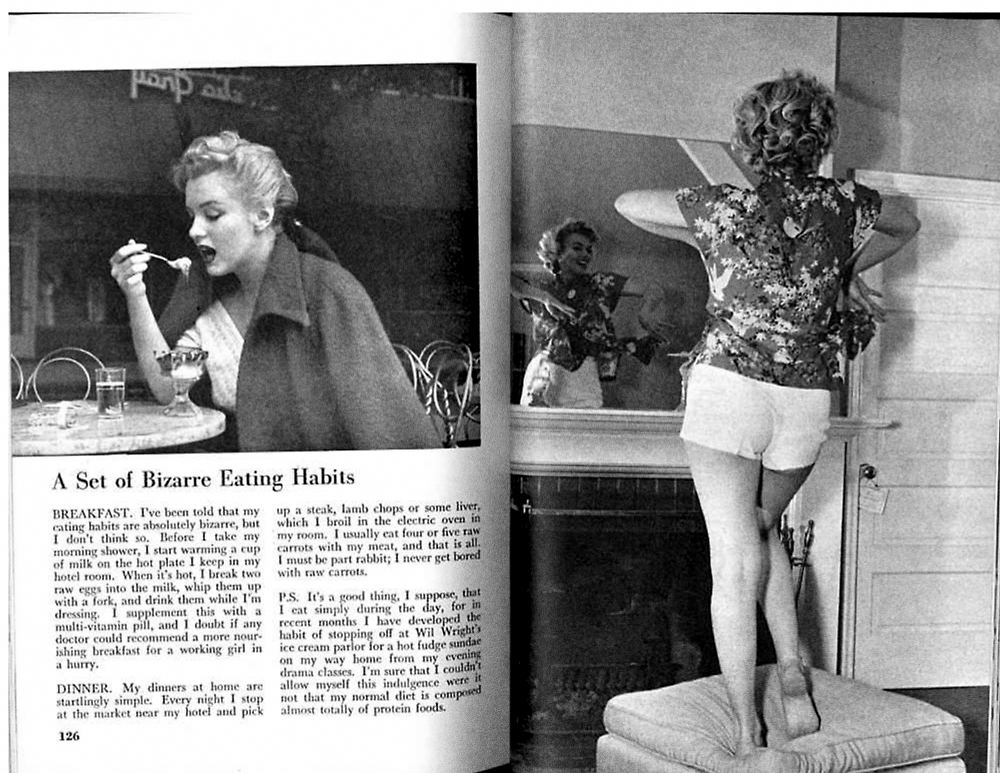
Marilyn Monroe is one of the those lifestyle icons most of us interested in vintage style venerate. I’m no exception, though I’m rather late to the party. I’ve been meaning to find the biography Gloria Steinem wrote about her life; I had no idea she’d been written about by a proper feminist scholar. She is a fascinating figure, both as a study of self fashioning and persona, as well as a woman who built herself up from an awful childhood. There’s a great interview with her from the Pageant, circa 1952, in which she discusses her exercise and eating habits–pretty fascinating. (source)

marilyn-monroe-in-bed-pic

marilyn-monroe-workout

marilyn-monroe-body

marilyn-monroe-diet

The Mystery Hand Crank

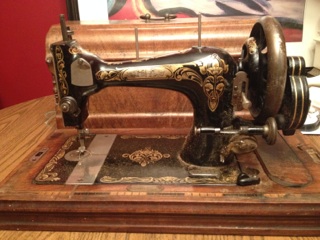
So the old girl arrived intact, miraculously, and with some oil in the lock and some careful maneuvering (and the highly technical piece of equipment, the butter knife) I was able to get the cover off without damaging anything. It was unlocking fine, but had been kind of jammed at a weird angle at some point, and just needed a teensy tiny bit of force in the right direction.

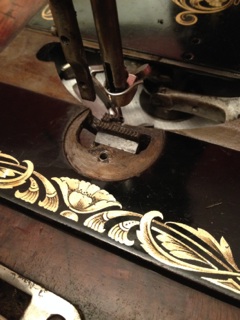
I felt like I was opening Tutankhamen’s tomb as I opened it up and found everything pretty much intact under a thin layer of dust. The decals are in gorgeous shape.

IMG_16861

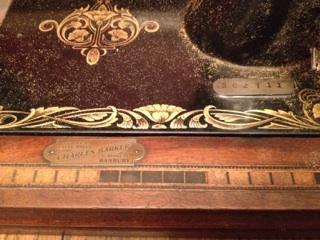
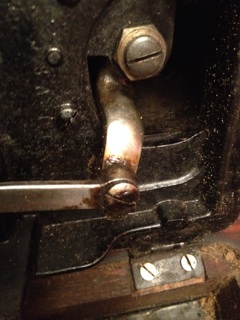
But no name or badge! It says “Charles Barker, 21 Bridge St, Banbury. Cutler and Cycle Maker.” on a small plate in the front, but I am willing to bet this is just the shop that sold these rather the the manufacturing party. There is a faint “A” visible with some wings or something around it, but it looks as if there may be more letters that were there originally. I thought maybe it was a Pfaff with a post WW1 paint job, but the bobbin winder and stitch lever don’t seem to be right for that. The case looks very much like a Pfaff or Gritzner of the era, but small details seem to conflict with that hypothesis. It’s a puzzling combination of typical German details–white porcelain handle, fine inlay in the the wooden case, stitch length lever that allows for reverse and  is labeled R/V (“vorwarts” is forward in German) instead of R/F–and a Singer or maybe Vesta style bobbin winding assembly. The hand crank mechanism is also different than the Singer style I’m familiar with, and seems actually better engineered.

IMG_16871

IMG_16881

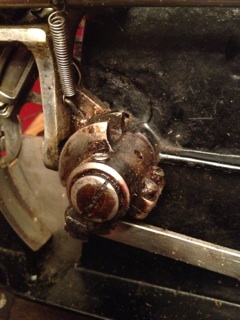
IMG_16911I can’t quite figure it out. It does turn, but despite its pristine appearance, internally it’s a gunked up godawful mess. It looks like someone lubricated it liberally with carriage axle grease or something.

IMG_16931 IMG_16941IMG_16991   IMG_16961IMG_16951I’ve been obsessively chipping away at it all weekend. It’s surprisingly smooth after a good oiling, but there is a catch when cranking at slow speeds at the point at which the needle is at its highest. If cranking quickly, the momentum takes it around with no problem. But the slower one cranks, the more noticeable it is. I think it’s probably gunked up old oil somewhere I can’t reach, but I’m hesitant to try it much until I can eliminate that catch.

Also: want to see what 80-100ish years of not cleaning the lint out of feed dogs looks like?

IMG_17051

A hard, solid mass of fibers matted and gooed up into something I had to scoop out with a screwdriver. I’m still working on cleaning, of course, but this is what it looks like with some of the barnacles removed:

IMG_17081It’s funny, but this piece will probably be mostly just for display. When the decals look this nice I’m hesitant to actually use a machine. I prefer them well worn and broken in so that when I drop something and ding the surface or something I don’t feel like I’ve damaged a piece of industrial art so much as I’ve just made a tool more my own. I have another Singer 28 hand crank that has a lot of wear and faded decals and so far I prefer it because it feels less precious and more of this world than a history display. But I’m weird that way. I had similar feelings when buying a hand cranked coffee grinder recently. (I’m subconsciously preparing for the gridless zombie apocalypse.) I saw a lot of pristine ones online but went for a broken in, beat up one with a cracked base and some rust issues because I can steel wool off the rust, reseason the cast iron, and use it without feeling like I’m wearing down an antique. I like the idea of rescuing something from a scrap heap better.

Wardrobe Curation Inspiration, Tools, and Deep Seated Existential Angst.

This is a process I’ve tried and failed to execute multiple times. Here’s hoping the New Years DO ALL THE THINGS momentum will help me renew this project with a vengeance.

Here’s my shortlist of inspiration and refinement tools:

Into Mind on wardrobe refinement. (http://into-mind.com/)  This site is full of checklists and exercises and even a workbook to help refine one’s personal style into a steamlined, satisfying source of inspiration and pleasure. The author writes from a minimalist perspective, which I love, and even her blog page layouts are enjoyable examples of her aesthetic.

(Coletterie’s Wardrobe Architect.) Yes, yes, a thousand times, yes. How to define your style, your colors, etc, and actually plan your sewing in such a way that you create a wardrobe based on those principles. I cannot heap enough praise upon this series. I’m working through it right now to choose my sewing patterns/projects after way too many meh projects that aren’t exactly everyday wear anyway.

This might be weird, but, The Well Dressed Home by Annette Tatum. (It’s on Google books here.) While it’s intended to help you develop a style for your home decor based on your personal style, I find it very inspiring in a broader way. I like the way it establishes general styles and then shows creative ways to combine those styles. There is so much visual interest here that it’s impossible for me not to be inspired when I read this.

Style Statement, a book by Carrie McCarthy and Danielle LaPointe (see it on Google books here) which has a weird cult-ish following online and which is maybe 20% useful/80% too hippy fluffy for me, is nevertheless a useful tool for clarifying one’s own aesthetic. (They also love the Pareto principle.) The Manifesto of Style is fun food for thought. I very much enjoyed the book and the gorgeous visual design, but wasn’t struck by the lightning bolt of clarity when I “discovered” my two-word self descriptor. (Creative nostalgic. Pardon my French, but no shit. I could have identified that without doing all of the touchy feely self explore-y pages.) Mostly I find it interesting as a book full of beautiful things and interesting studies in specific personal styles. There’s also something intellectually important about exposing yourself to other worldviews; sometimes I find happy-hippy-self-fulfillment-actualizey speechifying to be a nice change of pace from my internal McConaulogues.

nothing-is-ever-over

biological-puppet

lets-go-to-work

I also have a hard time with the concept of identity as anything fixed or as anything so simplistic; I identify more with David Bowie figures who transform themselves repeatedly throughout their lives in accordance with whatever speaks to them best at a given time. So, in a nutshell, I’m thinking my sewing and wardrobe curation for winter/spring can be boiled down to: What would catwoman wear? Vintage style lines and silhouettes in a very simple, monochromatic palette (blacks, creams, a splash of oxblood here and there). Elegant and understated. Form fitting but allowing for movement and not revealing. Subdued feminine. My next move is to select about five patterns to stick with until I get them just right.

Vintage Sewing Library: Modern Pattern Drafting by Harriet Pepin

I adore old sewing books. These tend to have much more information than contemporary books, which may be due to sewing being a serious occupation for many more women during the first half of the 20th century than it is now in our era of cheap ready made clothing. *suppressing rant on exploitation built into system of production of cheap ready made clothing and why the first world nations have this luxury as hard as I possibly can* I’m going to work on adding many links to the vintage books I have found online, but for now, just one gem:

modernpatterndesign

Harriet Pepin. Modern Pattern Design. Available from Michou Loves Vintage, a gorgeous site in German. The download page is (here); Modern Pattern Design is under the expandable menu for “Schnittkonstruktion.”

Another source is (here), and yet another source is web based, through the Wayback Machine’s archived version of vintagesewing.info, a site (now unavailable) that was a rich resource of vintage sewing books. It is (here) and photos to follow are sourced from there.

It’s available for over $100 on etsy (here) if you’re into collectibles!

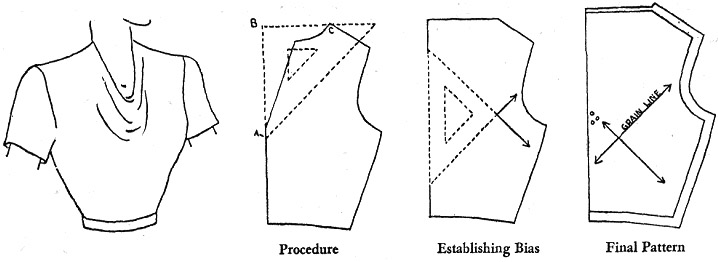
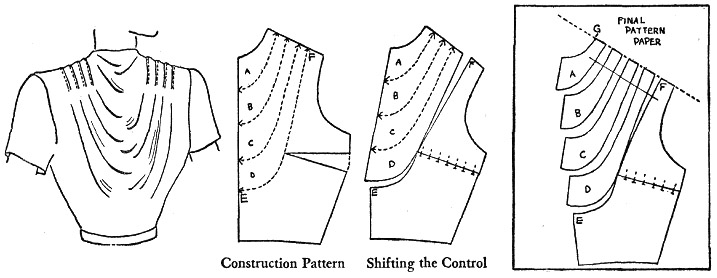
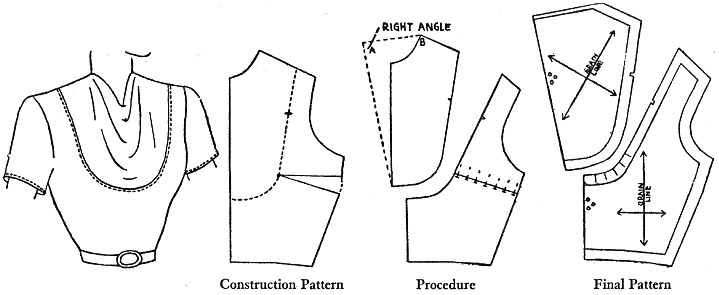
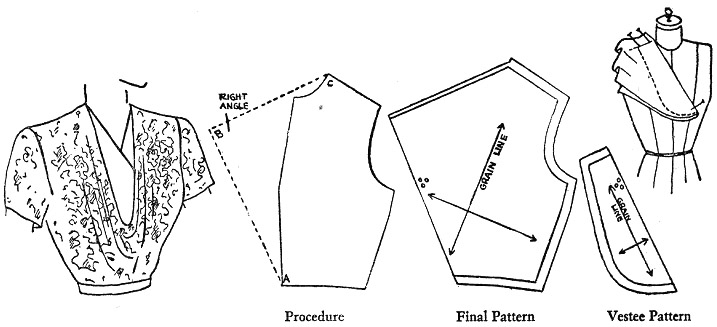
This book goes into incredible detail on constructing patterns from a basic sloper. To give you an idea of how well it shows pattern manipulations, here are several examples of how to modify a pattern to create various types of cowl necklines. I just did this on a jersey kimono top and it took me about an hour using a Threads Magazine tutorial. It was an involved, frustrating process. Next time, I will try one of these:

cowl1cowl2

cowl6 cowl5 cowl4 cowl3

And just one more gushing fangirl inclusion. I have been messing around trying to figure out bra making for my unique figure (broad rib cage, small bust, forward shoulder, etc) since bras have ALWAYS been a problem for me. Without the context of the bodice pattern around it, the bra cups and band are a bit puzzling and easy to screw up. Enter this sense-making illustration:

bratopBless you, Harriet Pepin. Bless you.

Mystery Sewing Machine ID

I’ve spent most of my night trying to identify a machine. I was fascinated by it because although it was labeled as a Singer the people listing it couldn’t get the wooden case off. In the pictures they posted, only what appears to be a white hand crank handle and a low bobbin winder are visible.

machine6

Fascinating, yes? I can’t find any Singer models with white or porcelain hand crank handles in that style. For awhile I thought it might be a Frister Rossman hand crank, since those often have the white handle and the fancy inlay in the case visible in this photo:

machine1

Those decals don’t look like anything I could find, either. The case is unlike any Singer cases I could find, though it definitely resembles a Frister Rossman. Here is the machine in question:

machine4

machine2 machine3 machine5

And below are some examples of Frister Rossman machines with similar cases:

12523826_1mfrhc

But unlike the Frister Rossmans, it has a low bobbin winder that seems to have the heart shaped cam mechanism similar to a Singer. The Frister Rossmans I’ve seen have a different design that lacks that rounded shape. I’ve seen Jones wooden cases that look similar, and Vestas sometimes use the cam on the bobbin winder.

I even tried using the key to identify the machine, but so far, no luck. Singers don’t typically have the teeth on the key as this one does. Treadleon discusses this (here) and explains that usually the older European sewing machines are the ones that do. Another site with replacement keys (here) has a similar one that is described as fitting most Vestas, Frister Rossmans and transverse shuttle machines. I know very little about transverse shuttle machines except that they take a needle that’s no longer manufactured (12×1) which is a pain.

So after about five hours of Google sleuthing, I’m still stumped. Excited to see what it is.

How Not to Ship a Sewing Machine

brando sadThis is my face today. I finally received a vintage industrial Necchi machine. A glorious 835-461. This is it’s state prior to shipping:

necchi1After being shipped from California to Missouri (for which the seller asked for more money for after the listing was over, which is peevish, though I have done this before when it seemed legit and I was happy with the packing they did) THIS is what I received:

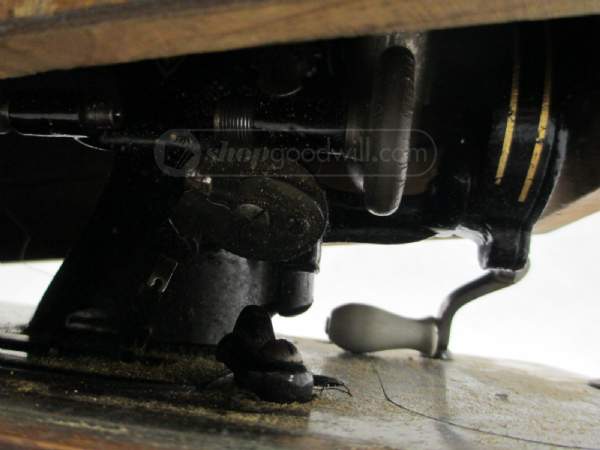
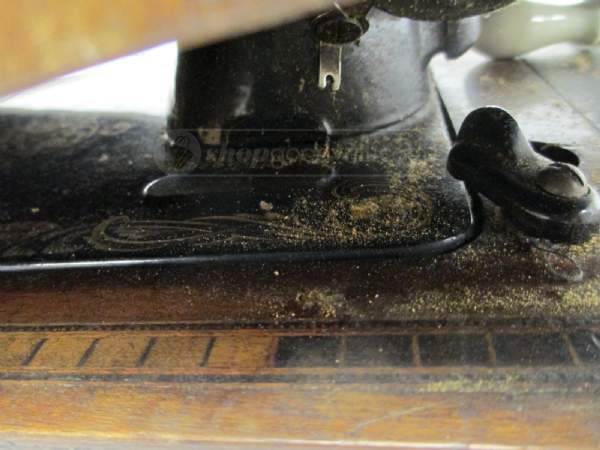
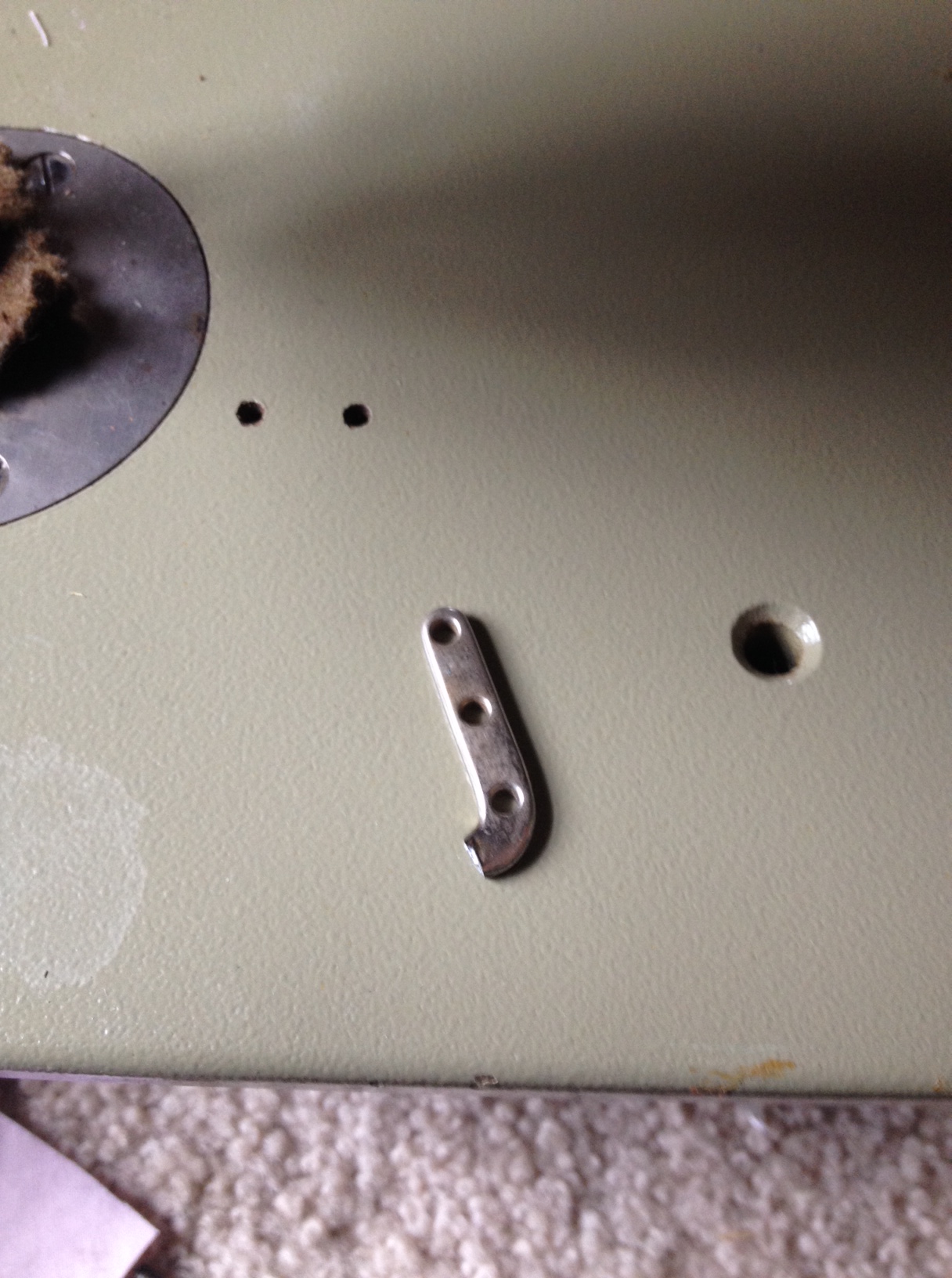
photo 1 photo 2 photo 3Broken stitch length selector knob, snapped off thread guide and completely busted metal thread-guide-y-mystery piece. I can’t even find info on this model, let alone replacements for those parts. I am NOT happy.

This is why you don’t ship 48lb vintage sewing machines in a single cardboard box surrounded by crumbled newspaper and a single layer of small bubblewrap.

What a f*cking waste.

For the record, the absolute best sewing machine packing job I have ever seen in my life was done by the ebay seller volksbug (here). He bubble wrapped every individual part possible, plastic wrapped everything securely in place, wrapped the machine itself securely in multiple layers of bubble wrap and foam, wrapped the speed control separately and secured it in place, put manuals and extras in bags and bubble wrapped and secured those, and placed all of this in a cardboard box so that it fit snugly and any empty space was filled with packing material. Then he placed this box within a larger cardboard box and filled the 3″ between the boxes with some kind of foam that hardens into firm but somewhat spongey consistency that absorbs shock perfectly during transit.

If only more sellers wrapped their wares so well. I’ve had packing peanuts jammed so far into the innards of machines I may never be able to get them out, many thread uptake levers broken off, thread tension loops broken or flattened, bobbin tire assemblies snapped in two, wooden cases and locks demolished from packing the machine locked in its case.

It’s a particular kind of heartbreak when it’s a rare antique that you just know you’ll never be able to fix or replace, but it’s more than that–it’s the loss of a piece of fine industrial craftsmanship from the world.

Excuse me while I go faceplant into some ice cream or something and mourn.

Christmas Sewing: Kimonos and Spock Shirts and Raglan Blouses, Oh My

I have three days, a 20 yard bolt of black stretchy chiffon, three shades of teal/navy blue jersey and black jersey, and a dream. I somehow think that I’m going to be able to finish four kimono tops and one raglan Spock style tee–and work a normal schedule!–over the next three days.

It isn’t going to happen. Thank you, Sephora, for backup girlie gifts.

But it will be fun to try.

I drafted my own pattern for the Spock shirt. My sister is a big fan, and she’s of the Zachary Quinto Spock era, so this is my guide:

trek-movie-spockLooks like a raglan tee with an almost sports-jersey texture, some kind of satin stitching or shinier bias tape at the seams which I’m pretending does not exist for my sewing purposes, and a black high collar that extends above the v-neckline. I tried sewing my son a version of this for practice, but he refuses to wear it. And I didn’t even get a chance to draw the eyebrows on him first.

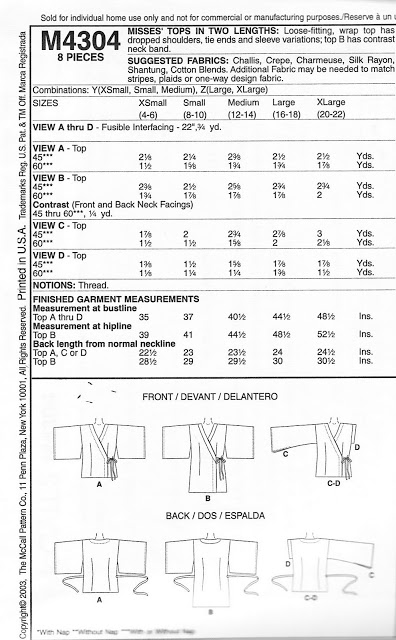
And then there’s the kimono top I settled on (instead of a caftan, which may be a bit too far into hippie land for the mass appeal I’m going for). McCall’s 4304 “2 Hour Top,” which I have sewn before and which took me significantly longer than 2 hours, but in the almost-year that has passed since my first attempt, let’s hope I’ve gained some speed. I want to modify it slightly, as the drawstring is a bit too high to flatter the apple body shapes with no discernible waistline that run in my family. I also might shorten and bell the sleeves slightly, and add a bit of length in a slight A-line to make the shape a bit more flattering.

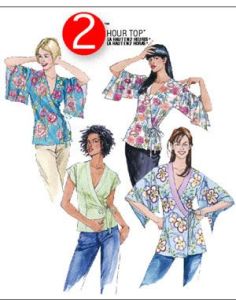
mmcalls4304backmccalls4304front

My plan of attack is vaguely industrial-sewing inspired (more on this in the future, as I find it fascinating in a best-practices efficiency kind of way):

  • cut all my pieces at once with a rotary cutter for precision
  • wind many bobbins ahead of time
  • sew the garments assembly line style. Do seam one on all four at the same time, seam two on all four, etc, to avoid confusion and having to figure out how to do each step all over again for each individual garment
  • French seams for side seams to avoid having to finish edges later and for neatness, especially on this fabric

I’m sewing it on my Kenmore 158.12111, which I am more and more happy with the more I use it. It has a dual belt system, which makes it slower than some, but incredibly precise. I can stop pushing the pedal and the needle stops within a stitch and it becomes really easy to time it perfectly after a little practice. It’s a little loud and little shaky, but I think that’s in part because it needs more use after sitting for years and in part due to the smaller base of a freearm giving it less balance. I’m very impressed by its strength and the regularity of its stitches–so far, it hasn’t given me any trouble at all. This is supposed to be part of the appeal of the Husqvarna models with the reduction gear, but the Kenmore has the advantage of being made of metal, being designed with room and smart access panels to get in there and oil and repair, and of using common bobbins and bobbin cases. To be fair, I haven’t really had the chance to enjoy a fully functional Husqvarna, but if the reduction gear is the key advantage, I’ll take a Kenmore any day for the sturdiness and simplicity.

Needless to say my collection of Husqvarnas is still nonfunctional. (I have four: the 19e I replaced a solid 19 3/4″ belt with a 20″ lug belt after days of struggle to attain much less than satisfactory results; a 1030 that is frozen completely solid and became a candidate for a very enjoyable Bacchanalian dissection and which I used as a source for a donor belt which was a big fail; a 6000 series with a broken camstack and a broken reduction gear which I’m going to try to replace with the gear from the 1030; and a 51e flatbed which appears to be in great shape except it has no cord and the plug is a weird type that I can’t find a replacement for. *shakes fist*)

AND I almost forgot! I finished my raglan blouse in a woven to my satisfaction and shall be sporting it in all its pastel pink glory for the festivities. I’ll have to post a picture when I’m not so dark-circle-tired-eyed and Sunday grosstastic.


Sewing Machines and Manuals: Vintage Bernina 740

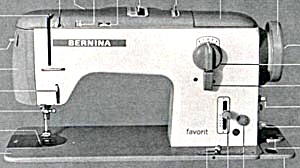
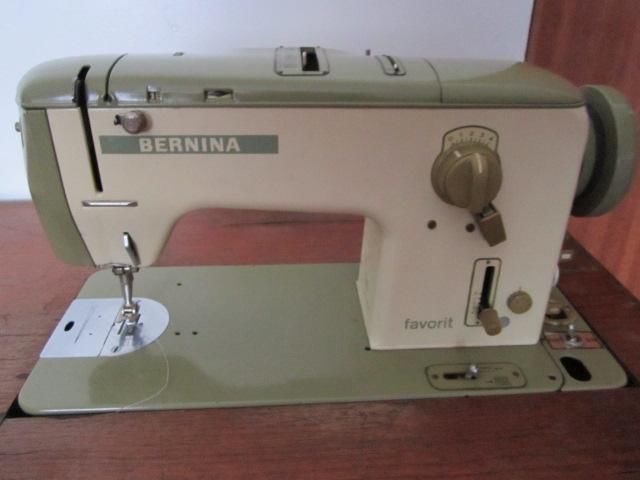
favoritSo I know I said the thing about the not hoarding any more machines. Sigh. But then I saw a machine like this, a Bernina 740 favorit, on ebay for super cheap listed by someone who seemed very grandmothery and knowledgeable and loving to her machines and could not, for the life of me, resist buying such a rare and well cared for piece. (image source) I realllly shouldn’t be spending more money on something I don’t need (I can hear the lifepartner now: ANOTHER sewing machine??!?) but I look at these as something like investments, in that I can love them and use them and learn with them but pass them on to other hands if I choose to some day and they probably will still be worth something after my heavy usage. Vintage sewing machines certainly don’t seem to be devaluing, especially high end models; reading sewing blogs from 5 years ago discussing the pricing makes this pretty obvious. And if I can actually apply skills I’ve taught myself to repair them, so much the better for the potential return on my “investments,” should it ever be possible to pry one from my clutches.

Berninas are held in high esteem by people all over the interwebz, but I’ve never tried one. I was drooling over a few Record 530, 630 and 730 models for a few months, but the Husqvarnas I’ve been trying vainly to fix really turned me off on anything with plastic innards and tight, enclosed motor free arm body styles. The beautiful thing about the Favorit models is that they are a) flatbed, meaning I can access the lower mechanical parts easily for cleaning and oiling, and b) at least some of them have an externally mounted motor, making for easier belt replacements if needed and even motor replacement if it came to that. The ebay description claimed an all metal construction, so I’m hoping that’s correct, as at least the 730 Record models have plastic parts (cam gear, etc) that do eventually wear out. c) It’s 60slicious. That cream and avocado color scheme. That font. Those curving lines. Why are contemporary sewing machine designs so inattentive to sheer visual pleasure?? This is fun to look at.

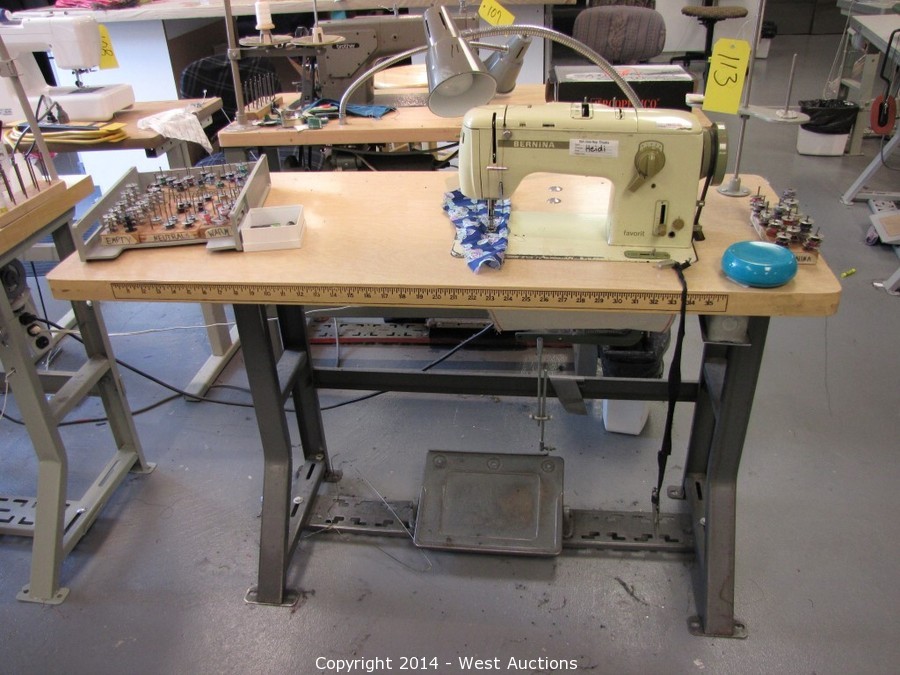
Another beautiful thing? Evidently these are possible to rig up to huge industrial motors. Like so:

westauctions bernina(image source)

I have seen 740 Favorit and 730 Industrie models, but am not sure what the difference is in the construction. The motors for the industrie ones are enormous and mounted below the machine, and I’m not sure how the sizes compare. But I will enjoy investigating!

740-11 industrie(image source)

So of course I had to seek out a manual, and was happy to find that Bernina has a page devoted to out of print manuals. (bernina manuals) The translation is clumsy, but it’s kind of part of the charm. The manual for the 740 is (here).

The ol’ girl should be arriving around Christmas time, which means I’ll be enjoying this new baby over some spiked eggnog. Can’t wait!